

Best Dirt Bike for a Snowbike Conversion: 300 vs. 450 vs. 500
If you're building a snowbike, choosing the right dirt bike matters more than choosing the biggest engine.
The question I hear most is simple:
"What's the best dirt bike for a snowbike conversion?"
Most modern dirt bikes—from 250s to 500s—can become capable snowbikes.
But some platforms put power to the snow better, carry less ice, and are easier to support.
After years of riding snowbikes, helping customers choose setups, and spending time on a variety of bikes and kits, here's my honest take.
The Short Answer
If you're building a dedicated snowbike, my recommendation is simple:
Buy a modern 450 motocross bike.
To be even more specific, buy a modern Austrian 450 motocross bike.
That means:
KTM 450 SX-F
Husqvarna FC450
GasGas MC450F
And if you really want my opinion?
That's the order I'd rank them in.
The differences are pretty small. If you love the color red, buy the GasGas. If white is your thing, buy the Husky. If you don't care about color and just want the benchmark snowbike platform, buy the KTM.
You really can't go wrong with any of them.
These are the bikes that most experienced snowbikers eventually seem to end up on, and there's a reason for it.
On snow, they simply put power to the snow more efficiently. They trench less, drive forward better, and maintain momentum when conditions get difficult.
Can I scientifically explain it?
No.
Have I seen it over and over again on the mountain?
Absolutely.
When the snow gets deep, heavy, or technical, these bikes consistently seem to rise to the top.
Another advantage that often gets overlooked is the powder-coated steel frame used on the KTM, Husqvarna, and GasGas platforms. They tend to accumulate significantly less snow and ice throughout the day compared to bikes with aluminum frames.
Does a little snow buildup really matter?
It adds up.
By the end of a deep powder day, that snow and ice can account for a surprising amount of extra weight hanging on the bike.
Don't believe me? At the end of your next ride, take a look at the snow and ice buildup on a KTM and then compare it to your buddy's Yamaha. The difference is usually pretty eye-opening.
Less snow buildup means less weight, less mess in the garage, and one more reason these Austrian bikes continue to dominate the snowbike world.
Why 450s Rule the Snow
Snow creates a tremendous amount of drag.
You're turning a track instead of a tire, pushing through deep powder, climbing steep hills, and often riding at elevations where horsepower is already reduced.
All of that takes power.
A modern 450 has enough horsepower and torque to keep the track spinning while maintaining momentum. You're not constantly asking the bike for more than it has available.
The nice thing is that today's 450s are incredibly rideable compared to the fire-breathing monsters we were riding 15 years ago.
They're powerful, but they're also surprisingly forgiving.
My Favorite Platforms
KTM 450 SX-F
If I had to choose one bike to build a dedicated snowbike around, it would be hard to argue against the KTM 450 SX-F.
It's light, powerful, easy to work on, and has tremendous aftermarket support.
Most snowbike manufacturers spend a lot of time developing around KTM platforms, and you'll find more snowbike-specific parts and accessories available for KTMs than just about anything else.
It's become the gold standard for a reason.
Husqvarna FC450
Think of the FC450 as the KTM's close cousin.
Performance is extremely similar and it makes an outstanding snowbike platform.
If you find a great deal on a Husky, don't hesitate.
GasGas MC450F
The GasGas delivers much of the KTM and Husqvarna package at a lower price point.
They're fun, capable, and represent one of the best values in the snowbike world.
The only thing worth mentioning is that the triple clamp design requires a little more attention during kit installation. It's nothing major, just something to be aware of.
When it comes to actual snow performance, the KTM, Husky, and GasGas are all extremely close.
Choose the one that makes you smile when you open the garage door.
What About Yamaha?
I'm also a big fan of Yamaha's 450 platform.
The YZ450F and YZ450FX are reliable, make excellent power, and seem to run forever with proper maintenance.
If you're already a Yamaha rider, there's absolutely no reason to switch brands just because you're building a snowbike.
That said, if your primary goal is a dedicated snowbike, I'd lean toward the YZ450F over the FX.
The FX makes a ton of sense if you're planning to ride dirt all summer and snow all winter, but for a dedicated snowbike build, I'd personally start with the motocross bike.
What About a 300 Two-Stroke?
Now we're getting into dangerous territory.
Ask ten snowbikers whether a 300 two-stroke or a 450 four-stroke is better and you'll probably get fifteen opinions.
A 300 two-stroke has some advantages.
It's lighter, simpler, and incredibly fun to ride.
I spent the better part of a season on a 2023 KTM 300 XC paired with a 2025 MTN.TOP Transfer.
Honestly, it was one of the most fun snowbike setups I've ever ridden.
The bike felt light, agile, and playful. It could be thrown around easily and was an absolute blast in the trees.
The downside?
It occasionally lacked that forward drive when you really needed it.
Most of my riding takes place between 4,000 and 6,000 feet in elevation, which seemed to be a sweet spot for the 300. The bike performed well and never left me disappointed.
When I started taking it on higher-elevation trips, however, the limitations became more noticeable.
The higher I went, the more I found myself wishing for a little extra horsepower.
For a first snowbike, I'm still steering most riders toward a 450.
What About a 500?
I get this question all the time.
People naturally assume that if a 450 works well, a 500 must work even better.
In reality, that's not usually the case.
Don't get me wrong—a 500 can make a great snowbike. If you're looking for one bike to ride all summer and all winter, it's definitely worth considering.
The biggest issue with the 500 isn't power. It's the transmission.
Most 500s come with a wide-ratio gearbox designed for dual-sport and off-road riding. That works great on dirt, where you're covering a wide range of speeds and terrain. In the snow, however, it can make it difficult to find the "just right" gear.
You'll often find yourself wishing for something between two gears.
The other challenge is power delivery.
Modern 500s come from the factory loaded with emissions equipment and tuned to meet street-legal requirements. As a result, they tend to feel a bit choked up compared to a stock 450 motocross bike.
Can you wake them up?
Absolutely.
But it usually takes additional money and modifications before they start making power comparable to what a stock 450 motocross bike delivers right off the showroom floor.
By the time you've added a tuner, exhaust, intake modifications, and spent time dialing everything in, you've often invested quite a bit more money into the bike.
If your goal is to own one bike that does everything reasonably well, the 500 deserves a serious look.
If you're building a dedicated snowbike, I'd still choose a 450 motocross bike every time.
Bikes I'd Avoid
This is usually where I save people a little money.
Could you build a snowbike around a 250 four-stroke?
Absolutely.
Would it work?
Of course.
Would it be my first choice?
Not even close.
The same goes for older trail bikes and lower-performance dual-sport bikes.
Can they be converted?
Yes.
Will you eventually wish you had more power?
Probably.
Most riders who stick with snowbiking eventually end up on a 450.
You'll save yourself some money by starting there.
I also intentionally left Honda and Kawasaki off my primary recommendations.
The CRF450 and KX450 can both make great snowbikes.
The challenge is that there simply aren't as many snowbike-specific aftermarket parts available for them.
That doesn't make them bad choices—it just makes the Austrian bikes easier to own and support.
My Recommendation
If you're shopping for your first snowbike conversion today, here's what I'd look for:
Modern fuel-injected 450 motocross bike
KTM, Husqvarna, GasGas, or Yamaha
Electric start
Reasonable hours
A bike that has been maintained properly
Don't get too hung up on finding the perfect brand.
A well-maintained bike is almost always better than the "perfect" bike that's been abused.
Final Thoughts
The truth is there isn't one perfect snowbike platform.
I've seen riders absolutely rip on 300s, 450s, and 500s.
But if someone walked into my shop tomorrow and asked what bike I'd recommend for a dedicated snowbike build, I'd tell them to start looking for a clean 450 motocross bike.
They're powerful, reliable, proven, and they simply work.
The best snowbike is the one that gets you out riding, but starting with the right bike makes the entire experience a lot more enjoyable.
Need help choosing a bike, kit, or complete build? Reach out to Moto365—I'm always happy to talk snowbikes and point you toward the right setup.
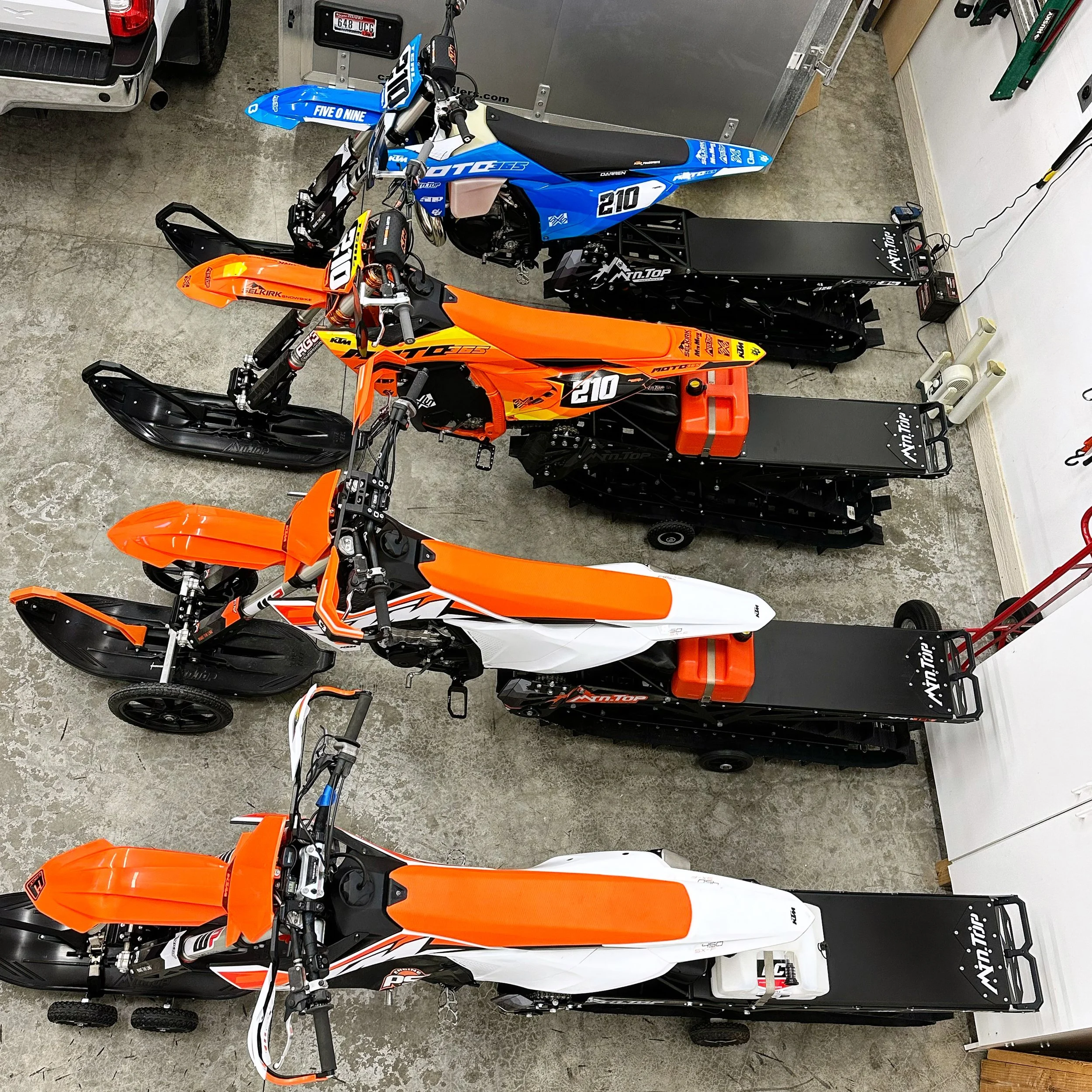
About the Author
Darren Teal has been riding snowbikes since 2010 and has spent over 14 years testing kits, building custom snowbikes, and helping riders throughout North America choose the right setup. He is an authorized MTN.TOP and CMX dealer based in Post Falls, Idaho.
